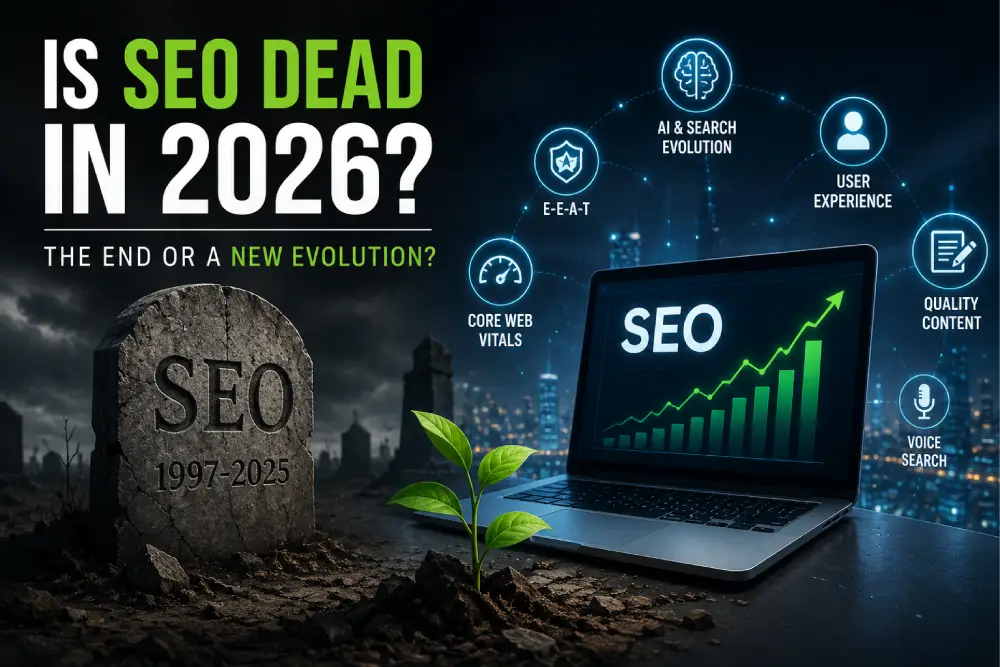
Every year someone declares SEO dead. In 2011 it was Panda. In 2012, the Knowledge Graph. Then featured snippets, then voice search. Now it’s AI Overviews and ChatGPT. The headline never changes — only the villain does.
So let’s answer it properly, with real 2026 numbers, not vibes: No, SEO is not dead. But the version of SEO built for 2020 is dead, and pretending otherwise will cost your business real traffic.
The fear isn’t irrational. Search behavior has genuinely shifted:
If your entire SEO strategy was “rank #1 and wait for clicks,” those numbers should worry you. That strategy is, in fact, dying.
This is the part most “SEO is dead” articles skip. Search demand hasn’t disappeared — it’s been re-priced and redistributed.
What’s still very much alive:
Three structural shifts explain most of what’s changed:
1. AI Overviews break the old ranking-to-click relationship. In 2025, about 76% of AI Overview citations came from pages already ranking in the top 10 organic results. By 2026, that overlap fell to somewhere between 17% and 38%. In other words, ranking on page one used to guarantee you’d also be the AI’s source — now it doesn’t. Traditional SEO and “getting cited by AI” have become two related but separate games.
2. Search moved beyond Google. People now split their research across TikTok for tutorials, Reddit for honest opinions, YouTube for deep explanations, and AI chatbots for quick synthesis. If your visibility strategy only accounts for the Google results page, you’re only fighting for part of the audience.
3. E-E-A-T became a filter for AI trust, not just Google rankings. AI systems are cautious about misinformation, so they lean toward sources they can verify — a real author, a real business, real credentials, consistent publishing history. Anonymous, AI-generated filler content is exactly what both Google and AI engines are learning to filter out.
This is where it gets practical — and honestly, encouraging. The businesses treating this as a re-tooling, not a funeral, are the ones pulling ahead.
Write to satisfy intent completely, not to hit a keyword. For a query like “SEO agency Toronto,” the real intent stack includes what results look like, what’s included in the service, pricing expectations, and proof it works. A shallow “we do SEO” page won’t rank or get cited. A page that actually answers the buyer’s real questions will.
Get structured. FAQ schema, Service schema, LocalBusiness schema — these aren’t optional extras anymore. They’re how you tell Google and AI systems exactly what your page covers, in a format they can lift directly into an answer.
Build real E-E-A-T. Named authors, real case studies, actual client results, a genuine “About Us” — these signals matter more now, not less, because they’re what AI systems check before they’ll cite you.
Prioritize commercial and local intent. Informational content is the most exposed to AI Overviews. Comparison pages, service pages, pricing pages, and location-specific pages are far more resistant, because people still want to evaluate and choose, not just be told an answer.
Track visibility, not just rankings.# Ranking 3 for a keyword means nothing if the AI Overview above it is answering the query and taking the click. Watch your appearance in AI Overviews, featured snippets, and “People Also Ask” boxes — that’s where visibility lives now.
Keep your website fast and technically solid. None of this matters if your site is slow or poorly built. A strong technical foundation — clean code, fast load times, mobile-first design — is still what everything else stands on.
SEO isn’t dead. What died is the idea that you could publish generic content, target a keyword, and coast on rankings alone. What’s replacing it is more complex, but also more rewarding for businesses that do the work properly: original content, real expertise, technical precision, and visibility across both traditional search and AI-driven answers.
That’s a bigger opportunity for the businesses that adapt — and a quiet disadvantage for the ones that don’t.