digiquack

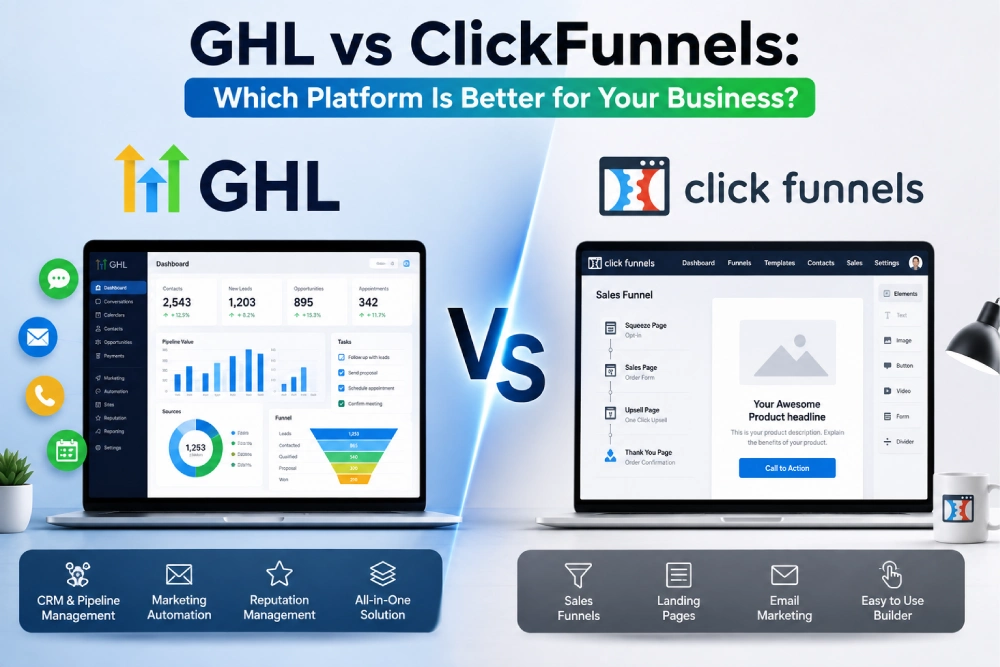
GHL vs ClickFunnels: Which Platform Is Better for Your Business?

GHL vs ClickFunnels comparison for business marketing and automation

If you are looking for a platform to build sales funnels, automate marketing, manage leads, and improve conversions, you have probably come across two popular names: GoHighLevel (GHL) and ClickFunnels.

Both platforms can help businesses create landing pages, sales funnels, email campaigns, automations, and customer journeys. But they are designed with slightly different priorities in mind.
ClickFunnels has built its reputation around sales funnels and conversion-focused marketing. GoHighLevel, now commonly known as HighLevel, takes a broader approach by combining funnels, CRM, automation, communication, scheduling, and other marketing tools into one platform.
So, which one should you choose?
If you primarily want to build and optimize sales funnels, ClickFunnels is a strong option. If you want to capture leads, automatically follow up with them, manage your pipeline, book appointments, communicate with prospects, and run your marketing from one place, GHL may be the better fit.

GHL vs ClickFunnels: Quick Comparison

Feature GHL (HighLevel) ClickFunnels
Sales Funnels
Landing Pages
CRM
✅ Advanced
Email Marketing
SMS Marketing
Marketing Automation
✅ Advanced
Lead Pipeline
Appointment Booking
Two-Way Conversations
Agency Management
✅ Strong
Limited
White-Labeling
Limited
Client Sub-Accounts
Less agency-focused
AI Tools
Ecommerce
Courses/Memberships
Best For
Agencies, service businesses & automation
Funnels, creators & online businesses
Features and plans can change, so always check the current platform documentation before making a purchasing decision.

What Is GoHighLevel?

GoHighLevel (GHL) is an all-in-one sales and marketing platform designed to bring multiple business tools together.
Instead of using one platform for your funnel, another for your CRM, another for email marketing, another for appointment scheduling, and another for lead follow-up, GHL is designed to connect these functions within one ecosystem.
HighLevel describes its platform as an all-in-one system covering CRM, funnels, email, SMS, calendars, automation, payments, and more.
For a service business, this can create a much simpler workflow:
Lead comes in → Lead enters CRM → Automated follow-up starts → Appointment is booked → Reminders are sent → Sales team follows up → Deal is closed → Customer receives onboarding messages.
The goal is to reduce the number of places where a lead can get lost.

What Is ClickFunnels?

ClickFunnels is a well-known sales funnel and marketing platform that focuses heavily on helping businesses turn visitors into leads and customers.
Its funnel builder allows users to create landing pages and sales funnels using a drag-and-drop editor without needing to code. ClickFunnels also offers features such as checkout, A/B testing, email marketing, CRM, appointments, automations, messaging, courses, community features, and ecommerce.
Its core philosophy is simple:
Build a funnel → Send traffic → Convert visitors → Increase sales.
And that is where ClickFunnels has historically been particularly strong.

GHL vs ClickFunnels: What's the Biggest Difference?

The easiest way to understand the difference is this:
ClickFunnels focuses heavily on the funnel.
GHL focuses on the entire customer journey.
Imagine you run a dental practice.
Someone clicks your Google ad and lands on your offer page.
They fill out a form but don’t book an appointment.
With a funnel-focused setup, the next step may require connecting additional tools to handle CRM management, communication, reminders, and follow-ups.
With GHL, the form submission can feed directly into the CRM and trigger workflows.
For example:
Form submitted

Lead added to CRM

Instant SMS sent

Email follow-up sent

Appointment link sent

Reminder sent before appointment

Missed appointment?

Automated rebooking sequence

Appointment completed

Review request sent
This type of automation is one of the biggest reasons service businesses and marketing agencies consider HighLevel.
HighLevel specifically promotes automated follow-up sequences, integrated calendars, CRM pipelines, and customizable workflows for agencies and service businesses.

GHL vs ClickFunnels: Funnel Building

This is one area where both platforms perform well.
ClickFunnels is famous for its funnel-building experience. Its current platform includes a drag-and-drop editor, sales funnels, landing pages, checkout functionality, A/B testing, stores, and other funnel-related tools.
GHL also provides funnel and website-building capabilities, including AI-powered funnel creation. HighLevel’s Funnel AI can generate funnel steps, copy, layouts, forms, calls to action, and associated follow-up workflows.
Winner: Depends on your priority
If your business is heavily focused on sales funnel creation and optimization, ClickFunnels is an excellent choice.
If your funnel needs to be tightly connected to your CRM, communication, appointments, and automated follow-up, GHL becomes particularly attractive.

GHL vs ClickFunnels: CRM

This is where the comparison becomes much more interesting.
A funnel tells you what happens to a visitor.
A CRM tells you what happens to the lead.
GHL is built around CRM and pipeline management. Leads can be organized according to stages, activities, appointments, conversations, and other customer information.
That means your sales team can see where prospects are in the buying journey and automate actions based on what happens.
ClickFunnels also now has CRM capabilities, including contact management, opportunities, appointments, and messaging.
However, if CRM-driven automation and sales pipeline management are at the center of your business, GHL is often the more natural choice.
Winner: GHL

GHL vs ClickFunnels: Marketing Automation

Automation is another important difference.
Both platforms support automated workflows.
ClickFunnels can trigger actions based on customer behavior such as opt-ins, purchases, and course completions. Its automation system can send messages, apply actions, and move customers through predefined journeys.
GHL takes automation further across the broader customer journey.
You can build workflows around things such as:
  • Form submissions
  • Appointment bookings
  • Appointment cancellations
  • Pipeline changes
  • Tags
  • Customer responses
  • Emails
  • SMS
  • Lead status
  • Follow-up sequences
This makes GHL particularly useful when your business depends on speed-to-lead and consistent follow-up.
Winner: GHL

GHL vs ClickFunnels: Email and SMS Follow-Up

Getting a lead is only the first step.
The real problem for many businesses is what happens afterward.
A potential customer fills out a form.
Nobody calls them.
Nobody sends an email.
Nobody sends a reminder.
The lead eventually forgets about the business.
This is where automation can have a major impact.
GHL is designed to bring CRM information, email, SMS, conversations, and automation together. HighLevel describes its system as connecting email with contacts, pipelines, and revenue data rather than treating email as a separate tool.
ClickFunnels also provides email marketing, messaging, and automation capabilities, so it is no longer simply a funnel builder.
However, for businesses where lead nurturing and multi-channel follow-up are critical, GHL has a strong advantage.
Winner: GHL

GHL vs ClickFunnels for Agencies

This is one of the biggest reasons agencies choose GHL.
If you manage marketing for multiple businesses, you don’t just need a funnel builder.
You need a system where you can manage:
  • Multiple clients
  • CRM accounts
  • Funnels
  • Automations
  • Calendars
  • Lead pipelines
  • Communication
  • Reporting
  • Follow-up campaigns
HighLevel is specifically positioned toward agencies and supports client/sub-account workflows and agency-focused capabilities.
This makes it particularly useful for agencies that want to manage marketing systems for multiple clients.
Winner: GHL

GHL vs ClickFunnels for Small Businesses

For a small business owner, the decision comes down to complexity.
If you simply want to create a funnel for a product, course, or online offer, ClickFunnels may provide everything you need.
But if you’re a local business that relies on leads and appointments, the requirements are different.
For example:

A roofing company

Someone requests a quote.
You need to:
  1. Capture the lead.
  2. Store their information.
  3. Send an immediate confirmation.
  4. Notify the sales team.
  5. Send follow-up messages.
  6. Get the prospect to book an appointment.
  7. Send appointment reminders.
  8. Follow up after the appointment.
  9. Track whether the deal was won or lost.
  10. Request a review after the job.
That is more than a funnel.
It is a lead management and automation system.
And this is where GHL can make a lot of sense.

GHL vs ClickFunnels for Coaches and Course Creators

This category is closer.
If you’re a coach, consultant, course creator, or digital entrepreneur, either platform can work.
ClickFunnels has strong tools for funnels, checkout, courses, communities, email marketing, and ecommerce.
GHL can also support funnels, CRM, email, automation, calendars, payments, and customer management.
If your business revolves around:
Traffic → Funnel → Checkout → Course
ClickFunnels is worth considering.
If your business revolves around:
Lead → Qualification → Appointment → Sales Call → Follow-Up → Customer
GHL may be the better option.

Which Is Easier to Use?

Both platforms are designed to reduce the need for coding.
ClickFunnels emphasizes its drag-and-drop funnel builder and positions it as a simple way to create funnels without technical skills.
GHL offers a much broader collection of tools, which means there can be more to learn.
That creates an important trade-off:
ClickFunnels can feel simpler when your primary goal is building a funnel.
GHL can feel more powerful once you need CRM, automation, pipelines, communication, appointments, and multiple customer journeys.
So the “easier” platform depends on what you’re trying to accomplish.

GHL vs ClickFunnels: Which One Should You Choose?

Here’s a simple way to decide.

Choose ClickFunnels if:

  • Your primary focus is sales funnels.
  • You sell digital products or courses.
  • You want a strong funnel-building experience.
  • Your business relies heavily on checkout and upsells.
  • You want to create and test conversion-focused funnels.
  • You don’t need highly complex CRM automation.

Choose GHL if:

  • You run a service-based business.
  • You need a powerful CRM.
  • You rely on appointments and sales calls.
  • You want automated SMS and email follow-ups.
  • You manage leads through a sales pipeline.
  • You want multiple marketing tools under one roof.
  • You run a marketing agency.
  • You manage multiple clients.
  • You want to automate repetitive sales and marketing tasks.
  • You want to reduce the number of separate marketing tools you use.

GHL vs ClickFunnels: The Bottom Line

There isn’t one platform that is automatically better for everyone.
ClickFunnels is an excellent choice for businesses that put sales funnels at the center of their marketing strategy.
GHL is a stronger choice for businesses and agencies that want to connect funnels with CRM, automation, communication, appointments, and sales management.
The important question isn’t:
“Which platform has more features?”
The better question is:
“Which platform fits the way my business actually gets and converts customers?”
If you are losing leads because nobody follows up, appointments are being missed, sales teams forget to call prospects, or your marketing tools are spread across multiple platforms, simply building another funnel may not solve the problem.
You may need a connected lead-to-customer automation system.
That’s where GHL can make a significant difference.

Need Help Setting Up GHL?

Choosing the platform is only the first step.
The real value comes from setting up the system correctly—your CRM, pipelines, funnels, calendars, email and SMS sequences, lead routing, reminders, and automated workflows all need to work together.
At Digiquack Technologies, we help businesses set up and optimize GHL systems designed to capture leads, automate follow-ups, manage appointments, and keep opportunities moving through the sales pipeline.
Instead of letting leads fall through the cracks, you can build a system that follows up consistently—even when your team is busy.
Ready to automate your sales and follow-up process?

Frequently Asked Questions

It depends on your business. ClickFunnels is particularly strong for building sales funnels, while GHL is designed as a broader sales and marketing platform combining CRM, funnels, communication, scheduling, and automation.
For many businesses, yes. GHL includes funnel-building capabilities along with CRM, automation, email, SMS, calendars, and other marketing tools. However, businesses that are heavily focused on ClickFunnels' specific funnel ecosystem may still prefer ClickFunnels.
ClickFunnels now includes CRM functionality, including contact management, opportunities, appointments, and messaging.

No. A complete rebrand also includes messaging, positioning, website experience, visual identity, and consistent communication.

Yes. Agency management is one of GHL's major use cases. Its platform is designed to help agencies manage client accounts and provide marketing, CRM, automation, and communication services.

GHL is generally the stronger choice if automated lead follow-up is a major requirement. Its CRM, workflows, messaging, pipeline, and appointment functionality allow businesses to build automated customer journeys around their leads.
Yes. Businesses can integrate different marketing tools when their existing workflows require them. However, one of the major advantages of GHL is that many functions that would otherwise require separate platforms are available within the same ecosystem.

Need Help or More Details? Get in Touch

We’re here to help—drop your details below and let’s start the conversation.

    Free Project Consultation Call

    Get the support you need at a price you can afford.