digiquack

GEO vs. SEO: What's the Difference and Do You Need Both in 2026?

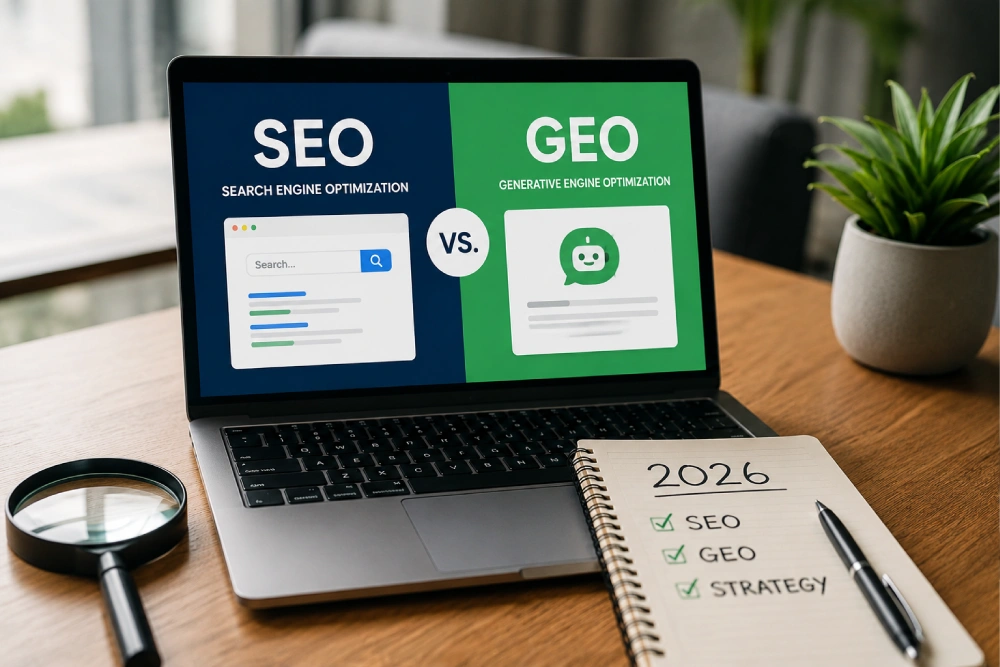
Professional digital marketing workspace showing the comparison between GEO and SEO strategies for improving online visibility in 2026.
Search is changing faster than ever.
For years, businesses focused on Search Engine Optimization (SEO) to improve rankings on Google and attract organic traffic. Today, however, millions of users are finding answers through AI-powered platforms such as ChatGPT, Google AI Overviews, Gemini, Claude, and Perplexity.
Instead of clicking through a list of websites, users often receive complete answers generated by AI.
This shift has introduced a new strategy known as Generative Engine Optimization (GEO).
So, does GEO replace SEO?
Not at all.
In 2026, the most successful businesses combine SEO and GEO to maximize their visibility across both traditional search engines and AI-powered search experiences.

What Is SEO?

Search Engine Optimization (SEO) is the process of improving a website so it ranks higher in traditional search engines like Google and Bing.
SEO focuses on helping search engines crawl, understand, and rank your pages for relevant keywords.
A strong SEO strategy typically includes:
  • Keyword research
  • Technical SEO
  • On-page optimization
  • Content marketing
  • Link building
  • Local SEO
  • User experience improvements
  • Website performance optimization
The primary goal is to increase organic traffic from search results.

What Is GEO?

Generative Engine Optimization (GEO) is the practice of optimizing your content so AI-powered search engines and assistants can understand, trust, and reference your website when generating answers.
Instead of ranking as a blue link, your content may be:
  • Summarized
  • Quoted
  • Referenced
  • Recommended
  • Used as a trusted source
GEO focuses on making content useful not only for search engines but also for AI models that answer user questions conversationally.

GEO vs SEO: The Key Differences

Feature SEO GEO
Primary Goal
Rank web pages
Get cited in AI-generated answers
Platforms
Google, Bing
ChatGPT, Google AI Overviews, Gemini, Claude, Perplexity
Focus
Keywords and rankings
Context, authority, and trust
Success Metric
Organic traffic
AI mentions, citations, and brand visibility
Content Style
Keyword-focused
Comprehensive, conversational, and factual
Optimization
Technical SEO, links, keywords
EEAT, entities, structured content, topical authority

Why SEO Alone Is No Longer Enough

Traditional SEO remains essential.
However, many users no longer click through search results because AI provides direct answers.
For example, someone searching:
“Which company offers the best AI SEO services?”
may receive recommendations directly from ChatGPT or Google AI Overviews without visiting multiple websites.
If your business isn’t recognized as a trusted source, you could miss valuable exposure—even if you rank well in traditional search.

Why GEO Isn't a Replacement for SEO

Some businesses assume GEO has replaced SEO.
That’s not true.
AI platforms still rely heavily on information that originates from well-optimized websites.
Without strong SEO, your content may:
  • Be difficult to crawl
  • Lack authority
  • Have poor technical performance
  • Miss valuable backlinks
  • Struggle to build topical relevance
Think of SEO as the foundation, while GEO extends your visibility into AI-driven search experiences.

How SEO and GEO Work Together

The strongest digital marketing strategies in 2026 combine both approaches.
For example:

SEO helps you:

  • Rank on Google Search
  • Drive long-term organic traffic
  • Improve keyword visibility
  • Increase website visits

GEO helps you:

  • Appear in AI-generated answers
  • Build brand recognition
  • Increase citations by AI assistants
  • Improve visibility across conversational search
Together, they create a more complete online presence.

SEO Best Practices in 2026

To remain competitive in traditional search, focus on:
  • High-quality keyword research
  • Fast website speed
  • Mobile-friendly design
  • Technical SEO audits
  • Strong internal linking
  • High-authority backlinks
  • Optimized title tags and meta descriptions
  • Helpful, original content
These fundamentals continue to play a critical role in search performance.

GEO Best Practices in 2026

To improve AI search visibility, your content should include:

1. Clear Content Structure

Use descriptive headings, short paragraphs, bullet points, and logical organization.
AI models can better understand well-structured content.

2. Strong EEAT Signals

Demonstrate:
  • Experience
  • Expertise
  • Authoritativeness
  • Trustworthiness
Include author profiles, client case studies, testimonials, and real-world examples.

3. Comprehensive Topic Coverage

Instead of publishing multiple thin articles, create complete resources that answer all related user questions.

4. Schema Markup

Use structured data such as:
  • Organization Schema
  • Article Schema
  • FAQ Schema
  • Service Schema
  • Breadcrumb Schema
Schema helps AI systems interpret your website more accurately.

5. Build Topical Authority

Develop clusters around core topics rather than isolated articles.
For example:
AI SEO
This strengthens your expertise and increases the likelihood of being referenced by AI.

Common Mistakes Businesses Make

Many companies unknowingly limit their AI visibility by:
  • Publishing thin AI-generated articles
  • Ignoring structured data
  • Targeting keywords without answering user intent
  • Creating duplicate content
  • Failing to update older pages
  • Having weak internal linking
  • Not demonstrating expertise
Avoiding these mistakes benefits both SEO and GEO.

Do Small Businesses Need GEO?

Absolutely
GEO isn’t just for large brands.
Local businesses, agencies, eCommerce stores, healthcare providers, educational institutions, and service-based companies can all benefit from AI search visibility.
As more consumers rely on AI assistants for recommendations, appearing in those responses can increase brand awareness and qualified leads.

The Future of Search

Search is no longer limited to typing keywords into Google.
Users now ask AI assistants questions like:
  • “Who provides the best SEO services?”
  • “Which company specializes in AI search optimization?”
  • “Recommend a digital marketing agency.”
Businesses that optimize only for traditional search risk missing these emerging opportunities.
The future belongs to companies that combine strong SEO foundations with effective GEO strategies.

How Digiquack Technologies Helps Businesses Succeed

At Digiquack Technologies, we help businesses stay ahead of evolving search trends by combining traditional SEO with modern AI search optimization.
Our services include:
  • SEO Strategy
  • Technical SEO Audits
  • Generative Engine
  • Optimization (GEO)
  • Google AI Overview Optimization
  • AI-Friendly Content Strategy
  • Schema Markup Implementation
  • Topical Authority Development
  • AI Search Visibility Audits
Whether your goal is higher Google rankings or better visibility across ChatGPT, Gemini, Perplexity, and other AI platforms, we create strategies designed for the future of search.

Final Thoughts

SEO and GEO are not competing strategies—they complement each other.
SEO helps search engines discover and rank your content, while GEO helps AI systems understand, trust, and recommend it.
As AI-powered search becomes a larger part of how people find information, businesses that invest in both approaches will be better positioned to attract traffic, build authority, and reach customers wherever they search.
If you’re planning your digital marketing strategy for 2026, don’t choose between SEO and GEO. Build a strategy that includes both.

Frequently Asked Questions

SEO focuses on improving rankings in traditional search engines, while GEO focuses on making your content more likely to be cited and recommended by AI-powered search platforms.
No. GEO complements SEO. Strong SEO provides the technical and content foundation that also supports AI search visibility.
More users are relying on AI assistants and AI-generated search results. GEO helps ensure your content can appear in those experiences.
SEO is still essential, but relying only on traditional search may limit your visibility as AI search continues to grow.
The best GEO content is well-structured, comprehensive, trustworthy, and focused on answering real user questions rather than just targeting keywords.
Schema helps AI systems better understand your website's content, business information, services, and FAQs, improving the chances of accurate interpretation.
Yes. Businesses of all sizes can benefit from appearing in AI-generated recommendations and answers.
Yes. Digiquack Technologies provides AI SEO, GEO, technical SEO, coDigiquack Technologies provides SEO, GEO, AI search optimization, technical SEO, content strategy, and AI visibility audits to help businesses improve their presence across both traditional and AI-powered search platforms. ntent optimization, and AI visibility audits to help businesses improve their presence across modern AI search platforms.

Need Help or More Details? Get in Touch

We’re here to help—drop your details below and let’s start the conversation.

    Free Project Consultation Call

    Get the support you need at a price you can afford.